
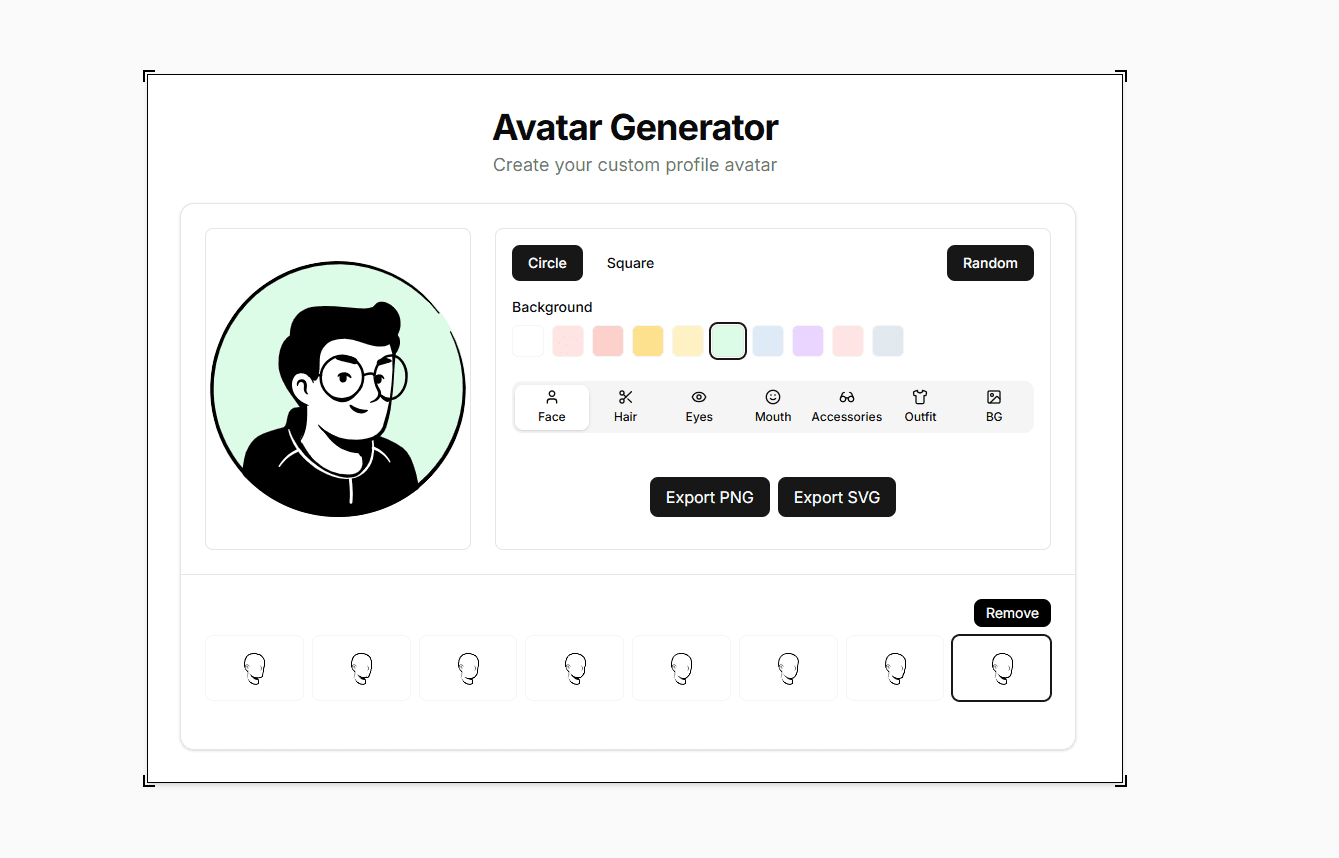
Avatar Generator
Modular web-based avatar creator with dynamic SVG assembly, random generation, export to PNG/SVG, and polished UX.
Timeline
2025
Role
Frontend / UI Engineering
Team
Solo
Status
In ProgressTechnology Stack
Key Challenges
- Composable SVG layering
- Export fidelity (PNG/SVG)
- State architecture for rapid updates
- Performance with dynamic re-renders
- Accessible interaction patterns
Key Learnings
- Optimizing SVG rendering pipelines
- Designing scalable component taxonomies
- Context-driven global state patterns
- Balancing UX polish with performance
Avatar Generator
Overview
The Avatar Generator is a fully customizable, browser-based tool that lets users build unique profile avatars through a clean, modern, and highly intuitive interface. It assembles modular, SVG-driven avatar parts—face shapes, hairstyles, eyes, mouths, accessories, outfits, and backgrounds—into a cohesive image that updates instantly as users interact with the editor.
Core Experience
- Modular Parts System: Each avatar layer (e.g., hair, eyes, accessories) is an independent SVG component stored under
public/avatar-parts, enabling easy extension and maintenance. - Instant Preview: Real-time assembly provides immediate visual feedback for every selection or randomization.
- Category Navigation: Tabbed or segmented UI groups avatar traits for fast scanning and selection.
- Random Generator: One-click shuffle creates a coherent avatar using weighted or default presets.
- Theme Support: Seamless light/dark mode integration for consistent usability and aesthetics.
- Export Options: Users can download avatars as PNG or SVG, choose circle or square framing, and apply solid or custom background colors.
- Background Customization: Preset palettes plus optional transparency or shape framing.
Architecture & Implementation
- Framework Stack: Built on Next.js 16 + React 19 with TypeScript for type safety and future-ready React features.
- UI Layer: Tailwind CSS 4 utilities + shadcn/ui components for accessible, consistent design tokens and interaction primitives.
- Rendering System: Layer composition performed by stacking SVG components in a predictable z-order; each part is selected via controlled state and rendered inside a root
<AvatarPreview />component. - Export Mechanism: A custom hook wraps
html-to-imageto generate raster (PNG) or preserve vector (SVG) outputs while handling shape masks (circle/square) and background injection. - Global State: React Context (or a thin custom provider) manages selected part IDs, randomization logic, and export configuration separate from presentation components.
- Performance Considerations: SVG parts kept lightweight; memoization prevents unnecessary re-renders when non-dependent categories change.
- Developer Tooling: Biome ensures consistent formatting and linting; pnpm accelerates dependency workflows.
Key Components
AvatarPreview: Renders the composed avatar; applies shape mask and background.AvatarEditorContent: Layout shell coordinating category interactions and preview.CategoryTabs: Switcher controlling active avatar trait group.ItemSelector: Grid/list of selectable SVG variants with hover/active states.ExportControls: Shape, format, and background configuration panel.
Features in Detail
| Feature | Description | | ------- | ----------- | | Modular SVG Parts | Pluggable assets organized by semantic category | | Randomizer | Generates balanced avatars with valid combinations | | Shape Framing | Circle or square clipping applied pre-export | | PNG & SVG Export | Vector fidelity preserved; raster optimized for profile use | | Background Picker | Curated color set + optional transparent mode | | Theme Adaptation | Tailwind + shadcn tokens ensure consistent theming | | Accessible Interaction | Keyboard focus, ARIA labeling, color contrast compliance |
State & Data Flow
- User selects a category (e.g., Hair).
ItemSelectordispatches selection to Context.- Context updates current configuration object (e.g.,
{ hair: 'long-wave', eyes: 'happy', ... }). AvatarPreviewre-renders only affected layers.- Export hook reads the final DOM/SVG structure and converts to requested format.
Export Strategy
- SVG Export: Serializes inner SVG nodes; injects background rectangle if requested; applies mask for circular framing.
- PNG Export: Uses
html-to-imagewith scale factor for crisp rendering; preserves transparency unless a background is applied. - Fidelity Enhancements: Ensures consistent viewBox sizing to avoid cropping or scaling artifacts.
Randomization Logic (Planned / Implemented)
- Weighted selection to avoid incompatible or visually imbalanced combinations.
- Optional user constraints (lock a category while randomizing others).
- Seed-based reproducibility for sharing avatar codes.
Accessibility & UX Considerations
- Clear focus outlines and tab order for all interactive elements.
- Text alternatives / titles for each SVG part to aid screen reader context.
- Color choices validated for contrast in both themes.
- Smooth transitions without excessive motion (respects user reduced-motion settings).
Technical Highlights
- Clean separation between data (part registries), state (Context), and presentation (components).
- Plug-and-play part addition: drop an SVG file + update registry; no core refactor needed.
- Export pipeline abstracts format handling, enabling future additions (e.g., WebP, Base64 share links).
Challenges
| Challenge | Solution Approach | | --------- | ----------------- | | Layer Ordering | Fixed z-order map ensures consistent visual stacking | | Export Quality | Scaled PNG rendering + normalized SVG viewBoxes | | Performance | Memoized components + lean SVG paths | | Extensibility | Registry-driven architecture over hardcoded imports | | UX Consistency | Shared design tokens + component tiering |
Future Enhancements
- Palette designer & gradient backgrounds.
- Avatar JSON schema export for rehydration and sharing.
- Part marketplace or community contribution flow.
- Animated avatar states (blink, subtle movement) using CSS / SMIL.
- Bulk export / batch generation tool.
Why It Matters
This project demonstrates modular design, real-time visual composition, export fidelity engineering, and polished front-end ergonomics—valuable for profile systems, game character builders, social apps, or onboarding flows.
Closing
The Avatar Generator blends thoughtful UI/UX with scalable component architecture. Its foundation supports rapid iteration, future feature expansion, and real-world adaptation across multiple product domains.